With just a little forethought, tonight’s dinner is easily accomplished. Geena and I are getting back to meal planning on Sundays and with a grocery, meat and fish list, great meals are really only 30 minutes of prep time.
Grilled salmon and peaches is a 30-minute prep meal. Begin by brushing both with olive oil and let them come to room temperature. Add Grand Marnier and some Allspice to the peaches for added flavor.
Plan to stop and pick up salmon on the way home from work. You will also need two peaches, quinoa, mint, a couple of carrots, celery, cucumber, asparagus and plain yogurt.
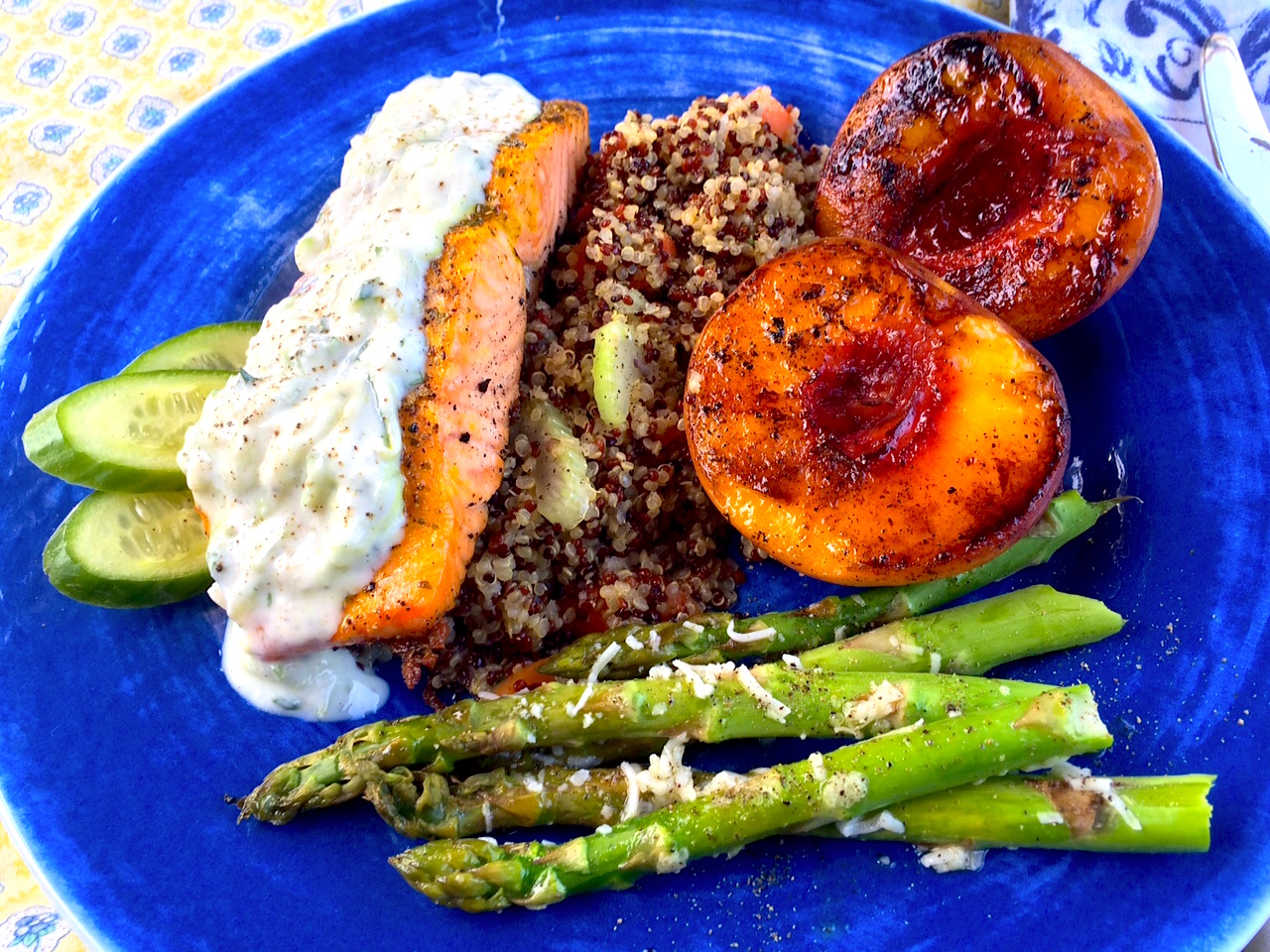
Dinner tonight: Grilled spiced salmon with homemade raita dressing, quinoa, roasted asparagus with Romano cheese and grilled peaches.
The trick to great salmon is brushing it with olive oil, adding cracked pepper and a touch of salt. Lightly drip olive oil over the peaches, add Allspice and drizzle (the secret ingredient) Grand Marnier before grilling.
The salmon takes about 8 minutes while the peaches about 6 minutes. It is a good idea to sear both but then grill them off the heat and bake them, allowing the wood and briquets to fill the BBQ with its great smokey flavors.
Salmon most often will call for a Pinot Noir. Tonight we choose a Cardwell Hill Cellars Pinot from the Willamette Valley in Oregon.
A great, healthy addition to this meal is quinoa. We added chopped celery and carrots to the quinoa at the very end to add a crunch and to ensure they stay crispy. The sauce or dressing on the grilled salmon is a homemade raita dressing. The cucumber dressing is a favorite in India and is built on a plain yogurt base. Add garlic, shredded cucumber, mint, cracked pepper and a teaspoon of salt.
It is a good idea to refrigerate this mixture for an hour before adding to the grilled salmon. The raita is a great topping as its crisp acidity adds interest to the rich flavor of the salmon. This works well with the spice and smokey char of the grilled fish.
This one dish meal is perfect with a Pinot Noir. We chose Cardwell Hill Cellars 2008 Reserve Estate Willamette Valley in Oregon. Contrary to what others have said online, this Pinot is a winner. I imagine it just needed more time in the bottle to “grow up.” This is a three-clone French-style Pinot Noir: Silky smooth, dark bing cherry earthiness and spice with vanilla and caramel notes. So pretty, light and clean. This can easily be enjoyed by itself or with grilled fish, roast chicken and pork chops. Loved it!
Be sure to return check out my Twitter @TalesoftheCork and on my Instagram (talesofthecork) daily postings. Please take the time to find me on Facebook as well at Facebook/TalesoftheCork. I also would covet those who would suggest a wine, restaurant, chef or hotel to visit. Feel free to contact me through social media or via email at talesofthecork@gmail.com.
If you can stop off at the grocery store or fish market on the way home, pick up some jumbo shrimp. They are easy to grill. Just season with your favorite spices, melted butter and parsley and hot sauce, grilling just off the heat.
Tonight’s meal began with seasoned jumbo shrimp dipped in butter and parsley. Geena and I each had a small pour of Cooper Vineyards 2012 Roundpen Rosé, Amador County.
With that being said, Geena and I had a chance to sit and relax on the patio and split four jumbo shrimp. I seasoned them with a favorite spice blend, added a couple of drops of hot sauce and served a small pour of Cooper Vineyards 2012 Roundpen Rose from Amador County, Sierra Foothills. While many Roses would be wonderful, the Cooper Rose is a refreshing blend made in the French style but look for their latest release.
Be sure to return check out my Twitter @TalesoftheCork and on my Instagram (talesofthecork) daily postings. Please take the time to find me on Facebook as well at Facebook/TalesoftheCork. I also would covet those who would suggest a wine, restaurant, chef or hotel to visit. Feel free to contact me through social media or via email at talesofthecork@gmail.com.
2010 Castello di Amorosa Pritchard Hill Melanson Vineyard Cabernet Sauvignon
I had the pleasure of tasting a first production wine just bottled during my visit. The 2010 six-barrel production of Castello di Amorosa Pritchard Hill Melanson Vineyard Cabernet Sauvignon is an aromatic dream. It’s classic barnyard, earthiness and plum overtones are a true connection to the terroir of the next expected Napa AVA.
This is shaping up to be a classic Left Bank Bordeaux. Already the lush velvety juice lingered long and the aroma seemed to fill the room after I swished the dark wine in the goblet. While the Melanson cab obviously still needs time to mature, this is going to be a collector’s AND drinker’s dream bottle of red in years to come. There is a six bottle minimum purchase at $125/bottle with a maximum of two cases.
Be sure to return check out my Twitter @TalesoftheCork and on my Instagram (talesofthecork) daily postings. I also would covet those who would suggest a wine, restaurant, chef or hotel to visit. Feel free to contact me through social media or via email at talesofthecork@gmail.com.
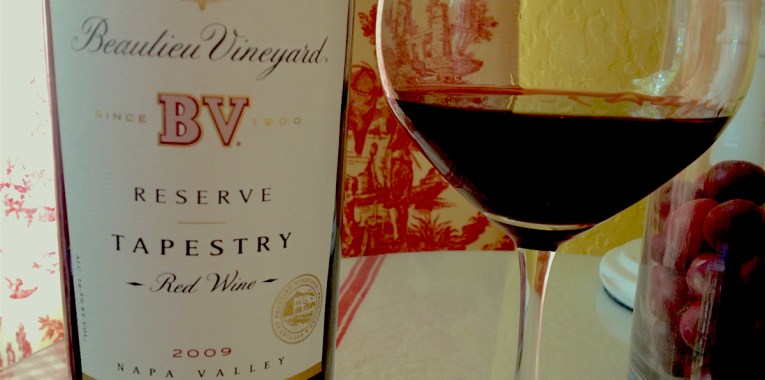
Beaulieu Vineyard Reserve Tapestry 2009 Napa Valley
For those of you whose pocketbook will not allow them to purchase the Aug. 17, 2013, Wine Spectator Daily Pick: Beaulieu Vineyard Maestro Collection Ranch No. 1 Rutherford 2009 for $65, I recommend a 91-point BV wine that still should satisfy even discriminating tastes for just over half the cost.
Since 1900, the Latour family has been farming the Napa Valley and helping create and add to its beauty. Since then the BV vineyards, vines and wines have been a part of the backbone of Napa Valley and Rutherford, California’s, history.
Beaulieu Vineyard Reserve Tapestry is a blend of Cabernet Sauvignon, Cabernet Franc, Merlot, Petit Verdot and Malbec. Its dark red fruit, flowers, licorice are some of the notes that emerge from this sleek, beautifully balanced red.
Beaulieu Vineyard Reserve Tapestry Napa Valley 09 is a blend of Cabernet Sauvignon, Cabernet Franc, Merlot, Petit Verdot and Malbec. Winemaker Jeffrey Stambor chose blocks of reserve-quality grapes which combine to create a wine that has soft tannins and is approachable/drinkable now.
The fruit is deep, dark and red–even jammy. First tastes are cassis and blackberry but give way to licorice, black cherry, plum and a hint of chocolate. There is a light minerality, spice, herb and earthiness to the blend while the floral notes slightly increase after opening.
Robert Parker in The Wine Advocate called the BV Reserve Tapestry 2009 “… A beautifully balanced red.” The Wine Spectator referred to the bottle as “Graceful, with complex spice, herb, dried currant and crushed rock flavors that are well-proportioned and gaining on the finish, where the flavors weave together with subtle nuances.”
While the suggested food pairing includes semi-hard cheeses like Bravo white cheddar, meat dishes, duck and mushroom dishes, I enjoyed my 2009 Beaulieu Vineyard Reserve Tapestry with a mesquite charcoal-grilled ribeye steak with a pomegranate red wine reduction sauce. The side dish was mozzarella, baby Roma tomatoes and basil fresh from the local farmer’s market mixed with vinegar and white balsamic. The Cabernet blend mixed well with the lightly braised tomatoes and complimented the peppery and smoky flavors of the meat. We used a fresh baked batard to sop up the juices.
While not BV’s top Cabernet or blend, the Beaulieu Vineyard Tapestry Reserve paired well with my ribeye steak. I recommend this 90-91 point wine and a value buy drinking well now.
The BV Tapestry is definitely a Bordeaux-style wine built with a California palate in mind. While previous years and their estate Cabernet’s may have more finesse and complexity, this red blend will be a crowd pleaser. The finish is long, fleshy and friendly. I believe this wine will continue to improve over the next three years. This may be the Cabernet you buy six or 12 bottles to open over time.
The BV Tapestry blend is 76% Cabernet Sauvignon, 12% Merlot, 6% Cabernet Franc, 5% Petit Verdot, 1% Malbec (Alcohol by volume: 14.8%). Drink now through 2017.
Currently this wine can be bought online through various outlets, including Beaulieu Vineyard Wines and WineChateau.com ($39.97). If you are willing to buy a case of this or mix and match wine, the shipping is free through WineChateau! Another excellent source to find a competitive pricing for wine is at Wine-Searcher.com.
The average price for this wine currently is $42 (excluding tax) and available for as low as $33 on the East Coast and $36 on the West Coast. Sample received courtesy Wine Chateau for review purposes.
The Beaulieu Vineyard visitor center is located at 1960 St. Helena Hwy. Rutherford, CA 94573. Call 800.264.6918, ext. 5233, or 707.967.5233 for more information. The tasting room also has wines that are not available anywhere else. The winery is also on Facebook at https://www.facebook.com/bvwines and Twitter at @BVwines.
Be sure to return check out my Twitter @TalesoftheCork and on my Instagram (talesofthecork) daily postings. I also would covet those who would suggest a wine, restaurant, chef or hotel to visit. Feel free to contact me through social media or via email at talesofthecork@gmail.com.
I spent three days in Sonoma County in July and, on a tip from David Scheidt, was privileged to meet Jim Rickards at his Alexander Valley tasting room in Cloverdale, CA. My premise for the trip was to taste first-rate California Rosés and J. Rickards Winery made the list.
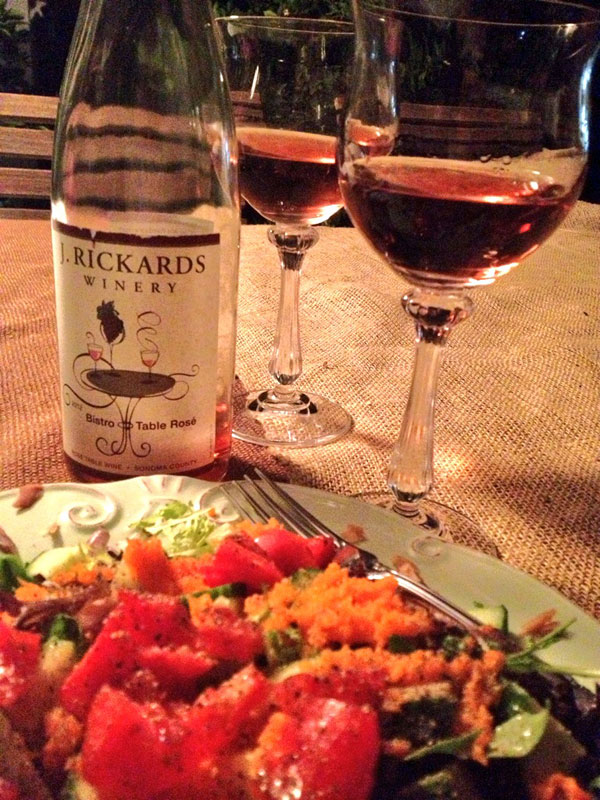
The J. Rickards 2012 Bistro Table Rosé is perfect for the European palate, with fragrant rose petal, strawberry, watermelon in a crisp, dry finish.
With the summer in full swing, I wanted to begin with J. Rickards aperitif-style Rosé; it was dry and rosy-pink. Perfect for the European palate, the slightly fruity wine is a sure “patio pounder.” The 2012 Bistro Table Rosé opens with fragrant rose petal and strawberry on the nose with a burst of watermelon and crisp, dry finish. The complex taste lingers and is versatile with food or by itself at poolside. Try this blend of 60% Aleatico, 40% Syrah (100 cases, $20).
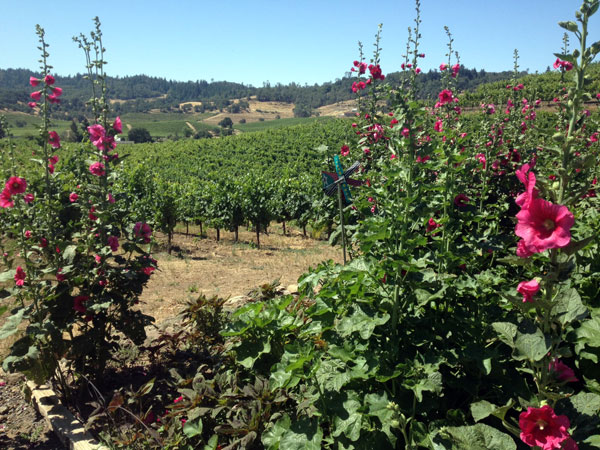
Just off of California Highway 101 north of Geyserville near Silver Oak Cellars in Sonoma County, the family-run operation of both wine grape farming and wine production is owned and operated by Jim and Eliza Rickards. They planted the vineyards starting in 1976, augmenting the original 1908 Old Vine Zinfandel block planted using horse technology.
When Jim left the military in 1969 with his military cut and large mustache, his dream was to work and own a winery.
“I wasn’t born into the wine business,” Jim said. I didn’t get it for nothing. I have worked my whole life for it.”
Hand-crafting small lot wines since 1991, Jim Rickards goal is to showcase the diverse soils and micro-climates of his vineyards. He has pioneered environmentally sensitive vineyard practices and been a proponent of sustainable farming techniques.
As their property had been in disuse and very little left from the original land owners, except the 105-year-old vines of Old Zinfandel planted by the Brignole family, the Rickards had years of development ahead of them.
In fact, the dream was so strong, they passionately recreated the early 20th century winery. He was told there was no water on the 60-acre ranch and that the best land use would be a rock quarry. Today, there are two wells and two large ponds providing water for all irrigation. Jim revived the original Zinfandel vineyard, adding new Zinfandel vines and later added Cabernet and Syrah, grafting much of their new stock. Born out of the encouragement of friends who have enjoyed the small lots of hand-crafted wine, the couple has been making wine since 1991.
As Jim began to share his passion for his wines, it became evident he was gifting me a personal history of his love for hand-crafted wines. His story includes pioneering environmentally sensitive vineyard practices and a long-time proponent of sustainable farming techniques. He spoke of losing 20 acres of vines in the late 80s-early 90s and replacing them with new disease resistant root stock. Jim’s tale includes nearly losing the farm to now growing 150 tons of grapes per year on his 45 acres.
J. Rickards Winery planned use of flowers, grasses, bird boxes and rainwater collection all add to Jim’s phrase whenever a visitor arrives: “Welcome to my house.”
Land stewardship is extremely important to Jim. The planting and mulching of wild flowers and grasses and the planned introduction of environmentally friendly insects all help to create pesticides free vineyards for 20 years. He builds bird boxes which have attracted songbirds like the Western Bluebird and Tree Swallow. His use of manures and composts help add minerals and beneficial bacteria to the vineyards. From collecting rain water to the building materials his home and tasting room are made of, Jim has created a winery which is sustainable and suitable for the land he farms.
While J. Rickards is Jim and Eliza’s dream, they raised two daughters and a son who do not carry their parents’ passion into their adulthood. This Sonoma County winery remains under the zeal and spirited direction of Jim who almost always addresses his visitors with “Welcome to my house.” Jim’s warm, inviting personality soon wins over those who visit the tasting room to try some of his 15 varieties of wine. He truly has lived out the phrase, “Friends are the family you get to choose yourself,” welcoming folks from all over into his circle.
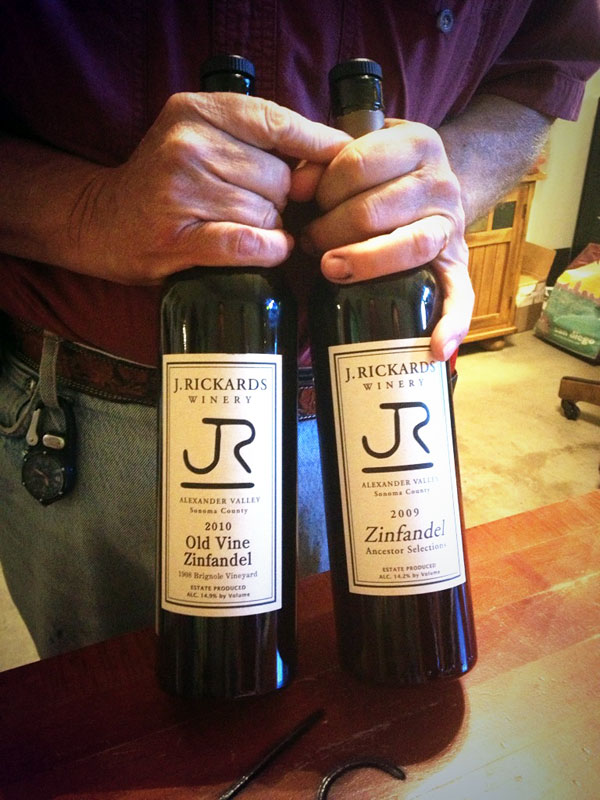
The Old Vine Zinfandel, Estate, planted in 1908 from the Brignole Vineyard, is flush with Blackberry and plum. The Ancestor Selections Zinfandel, Estate, is a prime example of the Alexander Valley with black cherry, raspberry and pepper.
While I tasted through much of his wines, I do want to recommend visitors taste side by side the Ancestor Selections Zinfandel, Estate and the Old Vine Zinfandel, Estate. I loved the elegance of the 2009 Ancestor Zin. The ripe black cherry, raspberry and spicy pepper were balanced and smooth (658 cases, $24).
Yet I am old school. I preferred the rich, old-world full-bodied “field blend” of the 2010 Zinfandel, Old Vine. The boysenberry, plum and gingerbread were gorgeous. The mocha and juiciness lingered. Jim blended 80% Zinfandel, 10% Petit Syrah, 5% Carignane, 4% Mataro and 1% of Alicante Bouschet (515 cases, $25). This is a must-buy for those not yet familiar with J. Rickards.
I appreciated Jim sharing how he hand-crafts his wines while pioneering environmentally sensitive vineyard practices and sustainable farming techniques. Yet despite all the accolades his wines have earned, Jim is passionate, not pretentious, allowing the wine to speak for itself.
J. Rickards dry Bistro Table Rosé with smoked salmon salad. This is a full-bodied wine that is great for almost any patio meal.
Before this gets too long, I also want to recommend J. Rickards 2010 Cabernet Sauvignon, Five Sisters Blend. It is fruit forward but made in the Bordeax-style. He smiles and calls it an $80 Cab in a $34 dress (322 cases).
Finally, the 2012 Sauvignon Blanc, Croft Vineyard is a Gold Medal winner at the 2013 North Coast Wine Challenge. I could smell and taste grapefruit, white peach, floral aromas, leading to fig and melon. This is great for summer lighter fare as well as richer foods like roasted chicken (1150 cases, $19).
With over 450 Sonoma County wineries, including J. Rickards, be sure to visit as there is sure to be wine to fit all tastes, pocketbook and pairing options.
For a short VIDEO introducing J. Rickards Winery and 2012 grapes, check out Wine Oh TV’s
Be sure to return check out my Twitter @TalesoftheCork and on my Instagram (talesofthecork) daily postings. I also would covet those who would suggest a wine, restaurant, chef or hotel to visit. Feel free to contact me through social media or via email at talesofthecork@gmail.com.





 TalesoftheCork blog