California Sierra Nevada Foothills Wine Region

Sierra Foothills Wine Region

While many rush to Napa Valley and its world-renown labels, the Sierra Foothill Wine Region has been quietly making wine since the Gold Rush of the mid-1800s. Boom towns across the Sierra Nevada range popped up nearly overnight. Soon thereafter higher altitude vineyards were planted with Zinfandel, Syrah and Petite Sirah, Viognier and even some Grenache grapes in granite and volcanic rock. The region is characterized by mining and lumber towns, four seasons, vineyard elevations of 1,500-3,000 ft. and art enthusiasts.

While Napa and Sonoma Wine Regions were approved as appellations years before, the Foothill region was accepted as a sub appellation in the 1970s. The area can be easily reached from Sacramento (1 hour) or even San Francisco (2 1/2 hours); restaurants and wineries in the Foothill area already provide a good alternative to the many nationally known super stars of Napa Valley.

Zinfandel grapes were first grown in the Shenandoah Valley since Gold Rush days. Over 100 wineries sprouted by the mid 1840-50s and operated until the mid 1880s when the destruction of old-growth forests and riverbeds brought legislation to end those practices. Shortly thereafter, as thirsty gold miners and forestry personal left the area, winemaking in the foothills declined.

While winemaking continued even through Prohibition, the region has been known for value-wines until the rebirth of the industry in the 1970s. However, the late 1990s brought new life to the region as cult and boutique wineries have sprouted bringing high quality wine to the region.

Sierra Nevada Foothills Wine Region is a wine and vacation destination just like the Napa Valley or Central Coast. The Foothill region spans from Sonora in the south to Jackson and Plymouth to Placerville and Auburn in the north. The quaint villages, their restaurants, hotels and bed and breakfast establishments are well suited to the historic trails. And the history of Gold Rush country is well worth revisiting.

This is one of three California focus wine regions for Tales of the Cork. The other two are Central Valley Wine Region and the Central Coast Wine Region. All are within a day trip of my home base of Fresno, Calif. and account for many of America’s most promising wineries and winemakers.

Explore Tales of the Cork with me. Read about the growth and influence of California’s winemakers, merchants and chefs. My goal is to find and develop relationships with them; my hope is to uncover and retell their untold stories. Be sure to leave a comment after each story; share your wine, winemaker or food experience.

Salut!

California Central Coast Wine Region

Central Coast Wine Region

Two and a half hours from the Central Valley is the ever expanding Central Coast wine region, located halfway between Los Angeles and San Francisco. The region includes Paso Robles, San Luis Obispo and even as far south as Santa Barbara. Vines were planted by the Franciscan monks in the late 1790s and were tended to via the many California Missions that doted the region.

According to Paso Robles Wine Country Alliance’s, commercial winemaking was introduced to the area in the late 1870s:

“Indiana rancher Andrew York began planting vineyards on his 240-acre homestead. Within a few years, he found that the vines were yielding more than he could market, prompting him in 1882 to establish Ascension Winery, known today as York Mountain Winery. The family planted some of the area’s earliest Zinfandel vines, making Paso Robles is famous for this variety. York initially sold his wines in San Luis Obispo and eventually as far away as San Francisco. Today, York Mountain Winery (located within the York Mountain AVA, adjacent to the Paso Robles AVA ) remains the oldest winery in continuous operation in the county.”

Throughout the Central Coast, the distinct soils and weather create unique, world class wines from Santa Barbara to Paso Robles.

Today, a wide variety of wines are grown on the Central Coast using grape varietals like Pinot Noir, Chardonnay, Cabernet Sauvignon, Merlot, Syrah and Rhône varieties. The wines have received world class recognition with many wineries winning top awards. I believe that Robert M. Parker Jr.’s prediction in the June 30, 2005, issue of Wine Advocate has already come true: “There is no question that a decade from now, the top viticultural areas of Santa Barbara, Santa Rita Hills and the limestone hillsides west of Paso Robles will be as well-known as the glamorous vineyards of Napa Valley.”

This is one of three California focus wine regions for Tales of the Cork. The other two are Central Valley Wine Region and the Sierra Nevada Foothills Wine Region. All are within a day trip of my home base of Fresno, Calif. and account for many of America’s most promising wineries and winemakers.

Explore Tales of the Cork with me. Read about the growth and influence of California’s winemakers, merchants and chefs. My goal is to find and develop relationships with them; my hope is to uncover and retell their untold stories. Be sure to leave a comment after each story; share your wine, winemaker or food experience.

Salut!
California’s Central Valley Wine Region

Central Valley Wine Region

As my palate evolved, my interest in Californian wines has expanded, wanting to appreciate both the vintner and the production process. I am interested in sustainable wine practices and am thankful for the wide variety of wine choices. And now with wine regions’ climat changing, I am even more aware of how climate, terroir and winemakers may need to research new techniques in order to produce higher quality wines in the 200-mile long (Tehachapi Mountains south of Bakersfield, north to Fresno County and Madera Wine Trail and up the San Joaquin Valley to the city of Modesto in the north) Central Valley region.

According to the Fresno County Farm Bureau, Thompson grapes are the most common planted variety in vineyards across the Central Valley.

Additionally, Viticulturists in the Valley are exploring additional vine varietal opportunities which provide new options for regional growth. In fact, hot weather grape varieties have been planted similar to the ones in Portugal and Spain.

Hot Central Valley summers have produced wine grapes (Thompson) that are traditionally blended with other grape varietals. However, the Central Valley grown Muscat grape is becoming more popular with the 21-34 age group who enjoy sweet Muscato wine. Yet, some have doubts that this or other varieties can flourish in the inland valley’s hot temperatures. That being said, a 2011 UC-Davis Central Valley wine study shows how the Central Valley‘s value-priced wine production is projected to increase and has developed a niche in the marketplace, especially wines that are meant for blending. While jug wines and table grapes have carried the wine region through the 1980s, Zinfandel, Tempranillo and Viognier, Chardonnay and Merlot have also been planted in the last decade. In addition, the Central Valley has developed Tawny port and dessert wines that have gained a reputation outside of the region.

The Central Valley is one of three California focus wine regions for Tales of the Cork. The other two are the Sierra Nevada Foothills Wine Region and the Central Coast Wine Region. All are within a day trip of my home base of Fresno, Calif. and account for many of America’s most promising wineries and winemakers.

Explore Tales of the Cork with me. Read about the growth and influence of California’s winemakers, merchants and chefs. My goal is to find and develop relationships with them; my hope is to uncover and retell their untold stories. Be sure to leave a comment after each story; share your wine, winemaker or food experience.

Salut!
Celebrate Fresno Restaurant Week(s)

The Fresno Regional Independent Business Alliance (FRIBA) was formed in late 2010 to educate, market and inform the public on the importance of supporting locally owned and independent businesses. One result of this group is Fresno Restaurant Week, now in its second year.

Actually it’s Fresno Restaurant Weeks, but whose counting.

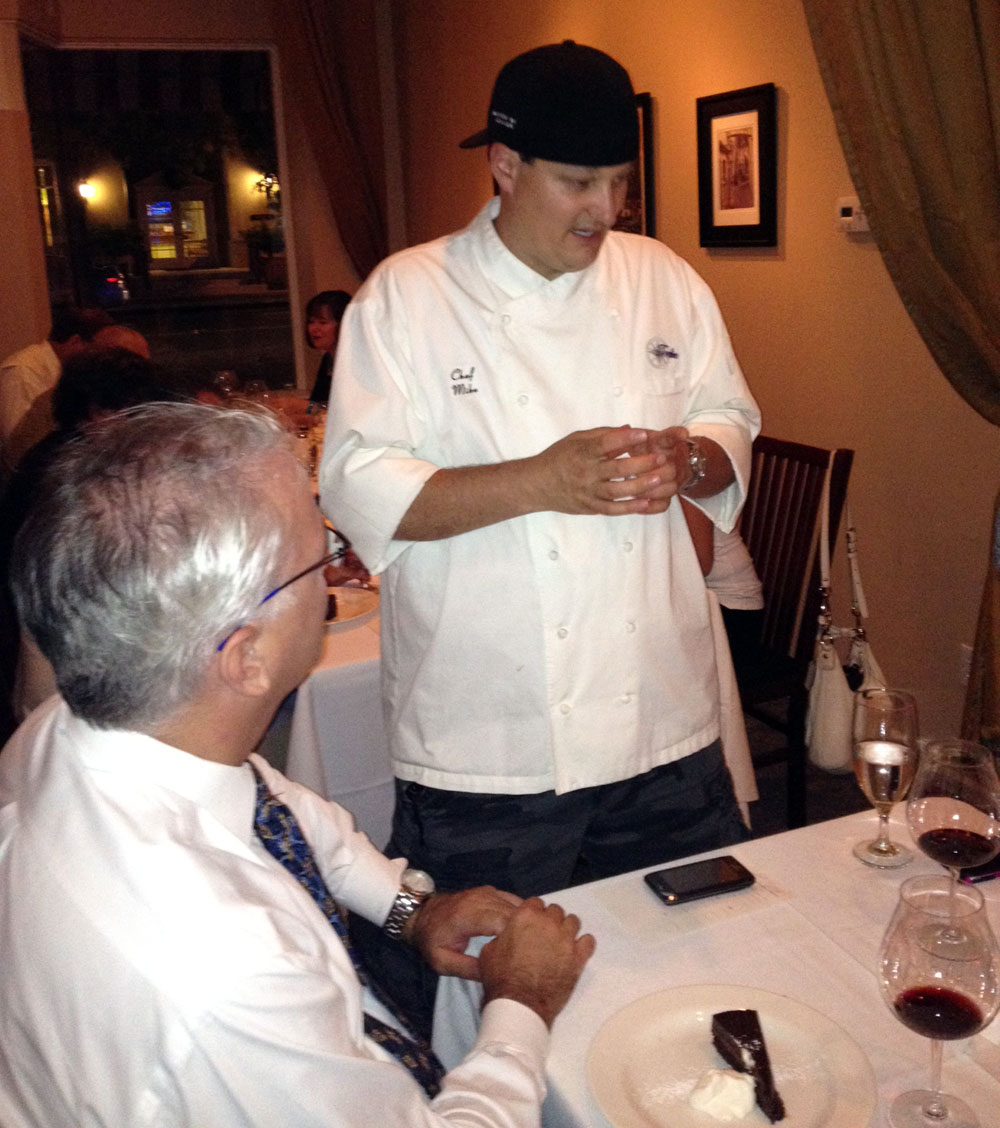
Chef, Mike Shackelford, often visits with Trelio patrons each evening after serving the main dishes. Located in downtown Clovis, Trelio is one of 25 Fresno area restaurants participating in the two-week promotion.

In an effort to educate the area community about independent local restaurants, FRIBA along with six sponsors, have listed 25 eateries for the 2012 Fresno Restaurant Week, July 20-Aug. 3. Amy Huerta, who works for the City of Fresno as the Local Business Initiative Manager, says that FRIBA serves all kinds of local businesses; Fresno Restaurant Week is just one way to grow area commerce and provide traction to develop the organization.

“I work for the City of Fresno, promoting independent businesses,” Huerta said, “and while I am not paid by the city to assist FRIBA, I do work with local business owners on how to develop the organization. My role is to help strategize Fresno Restaurant Week, including managing the promotion and media. I also partner with the organization to find innovative ways to educate our community.”

All 25 restaurants have paid a $500 fee in a cooperative marketing action plan. Huerta believes FRIBA not only has tremendous growth potential for the sponsors and businesses who participate, but also sees the organization developing and expanding to include other smaller cafes, bistros or restaurants who could not afford this year’s promotion.

“The impact of events like Fresno Restaurant Week are so important to understand. It’s an example of local businesses banding together in order to promote each other, and by doing so, improve the local community.”
–Amy Huerta, City of Fresno’s Local Business Initiative Manager.

“We are only a start-up organization,” Huerta said. “While we sent cards of ‘Save The Date’ to over 200 restaurants and actually visited many of those, not all could participate. We hope to expand Fresno Restaurant Week to twice a year. Hopefully more will be able to participate and the cost per business should go down. Our hope is to include even more smaller independent owners.”

According to Huerta, the $500 fee the 25 restaurants paid is projected to provide about $12,000 in advertising. Each participating restaurant posts a poster listing all participating eateries. They all put aside competition for the power of group marketing.

The auto industry learned a piece of this strategy years ago when they banded together and now can be located in auto centers rather than spaced miles apart.

Piazza Del Pane has a $22 pre-fix dinner menu which includes an appetizer, choice of entree, dessert, and a glass of wine.

FRIBA is not just for restaurants. According to their FRIBA’s web site, “Research shows that when a dollar is spent at a locally owned and independent business, on average that dollar will re-circulate three times the amount of money back into our local economy when compared to that same dollar spent at a chain business.”

This is true whether purchases are made from one of the local farmer’s markets to the guy who repairs shoes. A list of the FRIBA membership is on their web site; each pays $150 annual fee.

“The impact of events like Fresno Restaurant Week are so important to understand,” Huerta said. “It’s an example of local businesses banding together in order to promote each other, and by doing so, improve the local community. This is a great, innovative way for the people of Fresno and Clovis to try restaurants they wouldn’t normally visit and try new things. And it is good for the restaurants to try new price fix menus.”

Other cities across the country have organized restaurant weeks, including New York City and San Francisco. In fact, the Open Table, an Internet restaurant reservations site has a special web address just to organize Restaurant Week Specials and Prix-Fixe Menu Offers from Coast to Coast.

So Fresno County, while the chain restaurants like Denny’s, Outback Steakhouse or Olive Garden might be your favorite, consider opening up your wallet or purse for one of the locally owned independent diners, bistros, restaurants or cafes. Invite a friend or couple to join up for a night on the town. Most of the Fresno Restaurant Week participants have their special menus posted online. Scroll down to review each one, choose a place to eat and make a reservation. The coffers of Fresno County will be glad you did.

Salut!

In an effort to educate the area community about independent local restaurants, FRIBA along with six sponsors, have listed 25 eateries for the 2012 Fresno Restaurant Week, July 20-Aug. 3. (Illustration used by permission)

Outsider impacts Burgundy winemaking tradition, Part I

Burgundy winemaking is tradition and viewed as a right. Skills and vineyards are passed down from generation to generation, but occasionally a dreamer or upstart gains a foothold and sets root into Bourgogne’s Côte d’Or.

The Beaune Hospice, founded in 1443, was a place of refuge for orphaned children until 1970. Today the Hospices de Beaune are a testimony to its long history, continue to operate 60 hectares of vineyards and host a wine auction the third Sunday of November.

Born in Paris in 1963 to parents who were strangers to Burgundy, Ulrich Dujardin’s father moved the family to Nancy, France (east of Strasbourg, France) soon after for a job opportunities in the petrol industry. Later the family uprooted and settled in Dijon where Ulrich finished his schooling from 1971-1981. However, as he continued his schooling, working towards an education degree, Ulrich met disabled people in Beaune. The impression impacted him forever.

Ulrich’s father introduced his children to wine at an early age; a common practice for Europeans. His parents enjoyed wine and shared tastes with young Ulrich who gained valuable appreciation for its importance. Wine not only shaped dinner choices but cultural and community events they attended. And wine tasting with his father impressed and provided the impetus for Ulrich to occasionally cutting grapes from vines in the vineyards, influencing and honing early skills. But he could never allow himself to dream of becoming a winemaker. Burgundy winemaking was not in his family’s lineage.

I sat down with Ulrich and his wife Catherine one day in mid June to find out how a man born outside of Burgundy could thrive in a such a small town like Monthelie. In the next couple of posts, Ulrich’s story, despite my poor French skills, are what follows. And while Ulrich’s English is limited, Catherine’s struggle to translate French to English is also a part of the story.

“I grew up knowing about wines and vineyards from my father,” Dujardin said in broken English through his wife Catherine. “He gave me some tastes and I cut some grapes from the vine. This I never forgot.”

But as an outsider, Ulrich never felt or became a part of the winemaking community even after he met Xavier Bouzerand in 1986 of Monthelie, Burgundy, in the Côte de Beaune.

Ulrich Dujardin began to work for Xavier Bouzerand in the vineyards of Monthelie in 1986. The small village and surrounding slopes are 5 KM 3.5 miles from Beaune.

After graduating from school, Ulrich increasingly became interested in working with handicapped people after he took a tour of the Hospices de Beaune: a hospital for the sick and disadvantaged from 1443-1970. Ulrich was moved by the passion of the nurses while visiting the museum and decided to become a handicapped teacher.

Four years later, Bouzerand met Dujardin while Ulrich led a class field trip while working at a Center Aide Travail just outside Dijon. As a teacher who worked with adult handicapped people, Dujardin often took groups to work at temporary jobs. Disabled adults worked in places like woodshops and construction sites, assembly plants and repair shops. They also would help with catering and housekeeping opportunities and labor in the vineyards.

When Bouzerand and Dujardin initially spoke to one another, their communication centered on a handicapped member of Bouzerand’s family. Dujardin’s efforts with adult handicapped people at the non-profit agency impressed Bouzerand and the two men seemed to click; they both shared their expertise, keenly interested in what each other shared. A match was born.

Without a family tradition or land inheritance, Ulrich Dujardin decided to cut back to three days part-time teaching adult handicapped people in 1986. The other four days a week he accepted a position at Domain Bouzerand in Monthelie.

Soon afterwards, and upon Bouzerand’s invitation, Ulrich began making trips to work at the Bouzerand vineyards in Monthelie, about 42 km (26 miles) from Dijon, the region’s capital. At first the visits were on weekends and on holidays from his job at the Center Aid Travail. But within a year, Dujardin committed 50 percent of his time to the winery in Monthelie. He spent Monday through Wednesday working with handicapped adults and Thursday through Sunday working along side Bouzerand.

The aspiring winemaker worked seven days a week between the two business until Bouzerand accepted him as a 50-50 partner, changing the label from a single last name to Bouzerand-Dujardin in 1990.

It became increasingly clear to Bouzerand that his own handicapped son was not able to accept the responsibility of taking over the family winery; as a result, Dujardin’s dream began to emerge. He then focused his full-time energy on the winery. Even if he could not own the land, Dujardin was ready to take charge of a reborn Domain Bouzerand-Dujardin and its eight hectares. He retired from his teaching position in Dijon and its guaranteed salary.

He now became a full-time Vigneron.

Please return in the next couple of days for Ulrich Dujardin: Outsider impacts Burgundy winemaking tradition, Part II.