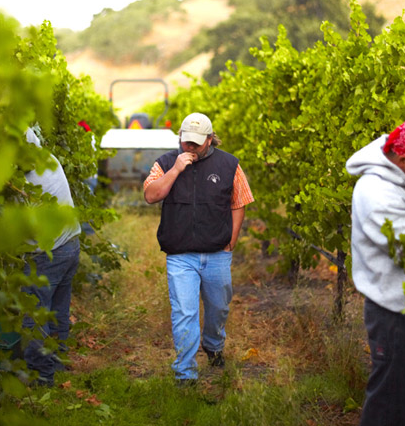
Rangeland Wines and Angus beef: Get to know Laird Foshay

Born in Nova Scotia, Canada, with Sottish and French heritage, Paso Robles raised Laird Foshay, complete with a cowboy hat and boots, intrigued me before I even arrived at the sprawling Rangeland Wines’ home base. I previously read Laird had been a Silicon Valley-type for half his adult life. However, I couldn’t believe for the life of me that, after ten years in computer magazine publishing and ten years as the founder of an investment news service business, he wanted to be a winemaker and rancher in the hills west of Paso Robles.

Once a web publisher for DrDobbs.com and the founder of Investools.com, an investment news service, Laird Foshay gave up his office job for wide open spaces at Rangeland Wines and the 1,500-acre Adelaida Springs Ranch in 2000.

Boy was I wrong. This Central Coast  winemaker not only has kept his ‘shirt and tie’ business savvy, but for the last 11 years has also added plaid, down-to-earth, unpretentiousness to his forté. His wife, Lisa, and him now operate both a winery, and the 1,500-acre  Adelaida Springs Ranch, including all-natural grass-fed 80 Angus beef cattle.

My trip to the Rangeland ranch house came after a visit with Mike Sinor of  Ancient Peaks Winery and Sinor-LaVallee. Despite my late arrival, Laird offered me a ranch guest room. We then talked well into the night, then picked up where we left off in the morning.

But before he shared his story, Laird was keen on giving me a circle tour of the ranch. We jumped into his white pick-up,  tossed the rifles in the back seat and proceeded to give me a personal tour.

The late, July sun seemed to illuminate the golden pasture grasses. The Angus beef grazing in the pastures were smaller than I had seen on other ranches, but the muscular build of the cattle stood out. The high mineral limestone soils created high-standing yellow grass and the animals looked fattened and sturdy after two years. He said the practice of rotational grazing, never allowing the animals more than 30 days in a pasture, kept them fit. The truck traveled down worn paths for almost two hours, and I never saw evidence of overgrazing. In fact, we passed by a few 1,300-pound specimens which Laird said were scheduled to be harvested in the days/weeks to come.

Through the hills, dozens of remarkable, natural springs gravity-fed the ranch’s needs and actually have been doing so since the Salinan Nation and the Chumash native peoples lived in and near this area hundreds of years ago. The many species of oak trees dotted the pastures, rocky outcroppings and at the edges of the vineyards. The laurel oak, live oak, blue oak and valley oak are all common to Paso Robles and the Adelaida Springs Ranch.

Rangeland owner Laird Foshay traded unstable high Internet dollars for fair/bargin-priced land in the oak-covered hills west of Paso Robles and a chance to be an Angus beef rancher and winemaker. He wanted a rural lifestyle and was willing to be a beginner to do it.

As we continued around the ranch, Laird shared his love for the land and the native peoples. We talked about the history of the old Adelaide and the Klau and Buena Vista Mines and mid-1800 homesteaders. Laird spoke as though his family had homesteaded the place, not like someone who had moved there from the City of Palo Alto, just 11 years before. Later, he even pulled out a 1992 copy of J. Fraser MacGillivray’s coffee table book, Adelaida. It is fabulous, self-published book on the history of the region, including manuscripts, photos, and newspaper clippings.

During our drive through golden pastureland, 40 acres of vineyards, past ponds, posts and ranch machinery, we talked about raw beginnings, watering holes, golden eagles and putting up with new visitors to the area: 250-700 pound wild feral hogs or even and maybe even a 200-pound  wild black Russian boar.

“This is a new wild frontier,” Foshay said. “The ranch is a place of opportunity and freedom for me and for our young winemaker, Shannon Gustafson. It’s about a new place. I’m reshaping my history.”

My thoughts turned to a NordicHardware.com, July 2012 article, which published Steve Ballmer’s comments of reshaping  Microsoft, despite its past success. Ballmer’s drive reminded me of Foshay’s confidence about reformatting his life. Laird’s courage and conviction was gripping.

“Hey, I’ve changed careers twice already,” Foshsay said. “I’ve taken a lot of criticism but few things are rocket science and this [ranching] isn’t one of them.”

The 2009 The Watershed (Cabernet, Merlot and Cabernet Franc blend) is one of nine Rangeland wines produced on an annual basis. Rangeland wines are offered through club membership on their web site or through over 20 area wine shops and restaurants.

As dusk fell, the California quail and hares skittered under twigs and piles of dead vine stock. The talk in the truck of  abundant wildlife, including wild turkey, deer, bobcat, mountain lion and bear, red-tailed hawk and a pair of bald eagles, seemed to give evidence of a healthy ecosystem beyond what Foshay was creating with his cattle. Laird added he brought on one other full-time employee in 2011: Nathan Stuart. Since last summer, Paso Robles-born Stuart has managed the vineyards, introduced grazing sheep in the vineyard and also kept the bees busy with the ranch’s honey-making venture.

Our drive ended back at the ranch house with talks of dinner before our conversation would turn to winemaking. Laird offered me a couple of Angus beef hamburgers. No take out or maid service here. The patties sizzled and the fat rendered like juice in a pan: simple western food that smelled of the land. He poured a glass of 2009 Rangeland Syrah Mourvedre. The Rhône varietals grow well in Rangeland limestone and sandstone soils. The Syrah’s robust gaminess and smokey characteristics are complimented by the fresh fruity Mourvedre bouquet, including hints of blueberry and blackberry and flavors of leather, clove, and vanilla. The super fine tannins and smooth texture heightened the organic, mineral-like depth taste of the burgers.

Over his home-grown dinner offerings, talk turned to the interior decor of ranch house. So much of it reflected the land we had just meandered through. The natural limestone and sandstone fireplaces, the huge picture windows overlooking the Santa Lucia Range, pastures and vineyards. Native artifacts found on the property were displayed carefully as if in a museum. Foshay’s crossbred 10-year-old Australian cattle dog, Silver, was welcome inside and out.

Laird wanted to talk about the original Dodd Ranch and Frank Sawyer’s homestead; Sawyer was the physician at the Paso Robles Inn 100 years ago. His son Marshall later bought the ranch land in the 1970s. The area’s history seemed far more important than his successful 20 years as one of Palo Alto’s “bit players” (his humble quotations) of Internet and finance. Heck we even talked about the Paso Mennonites who settled the area in the 1890s.
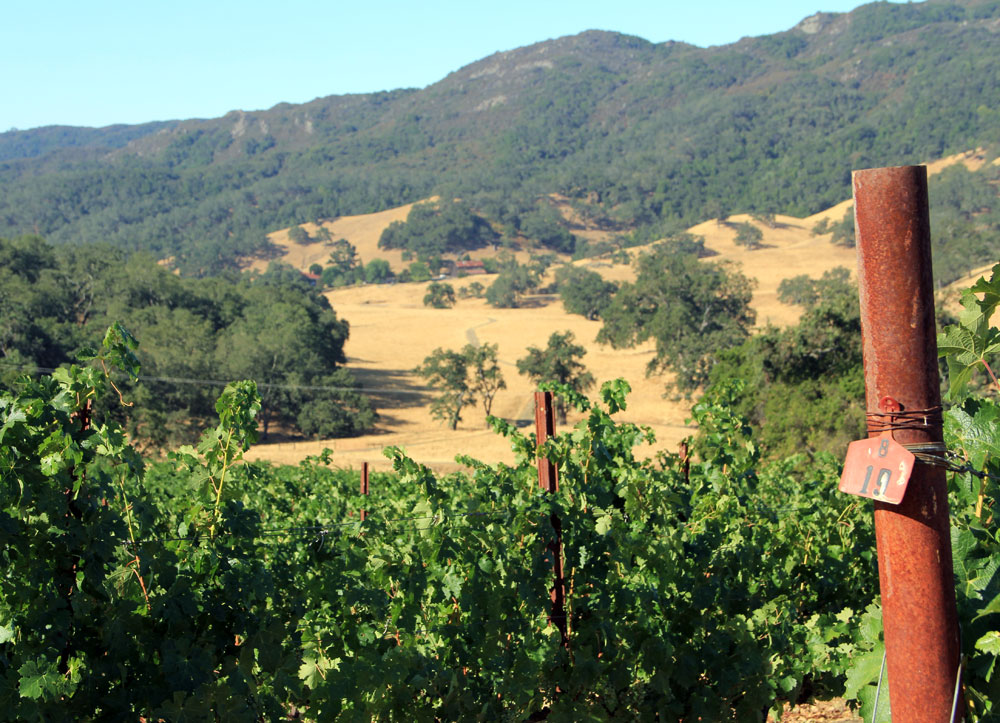
After planting his first Bordeaux vineyard in 2002 and Rhône varietals in 2008-09, former Silicon Valley entrepreneur, Laird Foshay, harvests vineyards growing at 1,700 feet among oaks, grasslands and Angus beef.

So then who is this University of California, Santa Barbara, history major? I kept telling Laird, “I am still having trouble figuring out how a guy who met Bill Gates and Steve Jobs in the early years of personal computer and Internet development, turned to ranching and winemaking? It just seems crazy.”

One thing for sure, Foshay no longer wears Polo shirts and has no intention of going back.

Please read the Sept. 14 post and the second part of this series: Frontier ranching in Paso: Rangeland Wines and Laird Foshay, Part II. Read as Laird put aside criticism and raw beginnings to produce wines worthy of acclaim. Laird lives on his Adelaida Springs Ranch with his wife Lisa. They have two college-age boys: Sam and Jackson and a high school senior, Angeline.
Get to know 2012 Coast winemaker of the year: Mike Sinor

Sinor LaValle owner a central coast mentor

Earning Wine Spectator’s praise for a 96-point Pinot Noir wasn’t enough to keep Mike Sinor fulfilled. In fact, neither was flying from Santa Maria to Napa for wine and dine lunches on a private Gulfstream jet. The trips to Burgundy and Bordeaux, France, to study winemaking and wine dinners with the Rothschilds were wonderful, but the ‘perks’ and awards always came while working for someone else.

After returning from France in 1996, Mike Sinor started his own wine label, Sinor-LaVallee, with his wife, Cheri, in 1997.

When the Paso Robles Wine Country Alliance and San Luis Obispo Vintners Association each named Mike Sinor California’s ‘2012 Central Coast Winemaker of the Year’ in mid July, the  Visalia, California, transplant soon traveled back to the Central Valley for a promotional event at The Market. Later that evening, Mike and I chatted at Trelio Restaurant during a wine dinner event. We agreed to meet a week later at the fabled Santa Margarita Ranch and  Ancient Peaks Winery, just south of  Templeton, Calif., in order for me to better understand the man behind the honor.

While Mike was raised in the center of agriculture in the State, his father, Bernie, an avid pilot, sold heavy construction equipment as owner and operator of Sinor and Sons Equipment company. Bernie gave young Mike plenty of opportunities to work on the job sites or at the family-owned Fresno junk yard. Mike spoke fondly of his father’s staunch commitment to his business, working hard but taking time to play hard with the family.

Bernie and Mike often went hunting together, and while it did not often include big game, father and son hunted doves in the foothills of Madera. And like many Central Valley residents, the family made numerous trips to Cayucos which is where Mike’s love of the beach began.

But working for Dad was not a part of Mike’s plan. College and the Central Coast beaches lured the high school graduate. The teenager ended up in San Luis Obispo; Mike enrolled at California Polytechnic State University [Cal Poly], ready to become the first college graduate in his family (Mike’s sister, Teri LaFleur, is now a 3rd grade teacher in Woodlake).

sinorstobbe2
I spent a morning with Mike Sinor, right, at Center of Effort in the Edna Valley where he works with a number of other winemakers and also creates his  Sinor-LaVallee brand.

“I was ready to go out on my own,” Sinor said. “My dad taught me my work ethic: to work hard and throw myself into it. So when I wanted to go to college, I had his blessing but I had to pay for it, work for it.”

Sinor’s upbringing, like many from the Central Valley, brought a love for the coast; Cal Poly was a natural choice. The Sinor family encouraged Mike to take responsibility for his education at an early age but expected him to pay for college. He entered Cal Poly hoping to become a high school shop teacher; however, upon meeting his future wife, Cheri, in a Chemistry 101 class, that dream changed: a love for each other and the wine-making journey was born near the beach in 1991.

Many Central California teenagers dream of leaving the San Joaquin Valley for a college beach experience. Mike Sinor left Visalia for San Luis Obispo and a degree from Cal Poly.

“My first job on the Central Coast was on old Corbett Canyon Road when I was 21,” Sinor said, “where I worked at many wineries, including Corbett Canyon Winery; that is where my winemaking training started. Claiborne and Churchill, Chamisal Vineyards, Saucelito Canyon, and Windemere Winery over the next three years (’91-’94). Initally, I had no idea what I was doing,” Sinor continued, “but these area wineries and winemakers became my community.”

Mike did more than just put in time at local wineries. He became a part of their families, including Bill and Nancy Greenough’s at Saucelito Canyon.

“We had previously lost a daughter when Mike showed up to work at our vineyard,” Nancy said. “While I had college kids around to be a positive influence to our youngest (Margaret and Tom), Mike Sinor lived out his time with us like their older cousin. Besides working that first harvest with us, there was not a job he wouldn’t do. Mike is an extremely positive person, has clear values, hardworking, and enthusiastic. He always did a job well.”

sinorskullcoe

Whether Mike picked the kids up from school or punch downs three times per night, Nancy said Mike found joy in whatever task he undertook. She never felt awkward about asking him to do the “crappy job” or the worst job at the winery. Mike had a Valley Boy reputation: always hard working. No job was beneath him.

“Mike was like a Junk Yard Dog,” Bill Greenough said. “There wasn’t anything he couldn’t fix: from tractors to wine equipment. Actually, I don’t know why he initially wanted to become involved with wine but he was so curious.

He always wanted a better way to do things, even if it involved the worst of jobs. He always volunteered: ‘I’ll do that…no problem.’ He willed himself to learn the wine process. He was so attuned to sensory changes to wine, juice, the smells, fermentation, pressing, barreling. His nose was always busy. He keeps an eye on stuff; his senses became like a hound dog sniffing, sniffing it out.”

Mike and Cheri’s personal wine label is Sinor-LaValle. Mike’s Spanish family heritage is the Sinor and Cheri’s background is French; thus the LaVallee.

Sinor not only had time for the wine business and babysitting the kids, but the Greenoughs said Mike took so much pride in completing even unusual tasks.

“We had this VW wagon sitting on our property; it had been parked for 10 years,” Nancy said. “Mice had moved into the camper: a 1966 Volkswagen Westfalia. Mike took it completely apart, got rid of the mice and put back together. He always brought out the best in people. The kids loved him.”

Today, Mike no longer wears a pony-tail under his baseball cap, something that Bill jokingly chided him for while Sinor lived in a house in the vineyards. Sinor, while living out a ‘Rush Limbaugh work ethic in the morning and country music in the afternoon,’ has given back to the Greenoughs. He has helped mentor Tom Greenough as he took over as Saucelito Canyon’s winemaker.

“I discovered myself because of them,” Sinor said. “They introduced me to my livelihood and I became so close to them; I not only worked by day, but I occasionally took care of their kids in the evening. Not only do I love my career but I also love the land and the people I am indebted to for my success. I love this community; it raised me.”

After graduating with a degree in Industrial Technology, Sinor began working for the Robert Mondavi family at Byron Vineyard in Santa Maria during the harvest of 1994. He rapidly gained respect as moved up from his cellar position to Assistant winemaker to Ken ‘Byron’ Brown.

Sinor’s background and passion for the land and vineyards also increased as he made two trips to France to study French winemaking processes with a focus on the vineyards and domains of Burgundy. These trips became even more personal as he married Cheri while on a trip to  Beaune, Burgundy, in 1996. A year later, Cheri and Mike started their own label: Sinor- LaVallee Wine Company. Their name is a ‘marriage’ of their two heritages: Sinor-Spanish and LaVallee-French. Their focus? Like that of their shared love: 300-400 cases of Pinot Noir.

Sinor worked with Byron Vineyards and Winery until November of 2000; he had seen production quadruple, a new winery built, and hundreds of new acreage planted. He left Byron after four years for his first winemaker position at Domaine Alfred [Chamisal Vineyard] in the Edna Valley and never looked back, despite what he gave up.

Sinor began his winemaking journey at Byron Vineyards and Domaine Alfred, where his 2004 Domaine Alfred Pinot Noir Edna Valley Chamisal Vineyards Califa earned 96-points from Wine Spectator. He currently works at Ancient Peaks Winery in Santa Margarita.

“It was very emotional for me to leave Byron after working with incredible people and the Mondavi family,” Sinor said. “No one could believe I was willing to give up the private jet excursions from Santa Maria to Napa for lunch or trips to Burgundy to learn more about winemaking. Why would this little guy from Visalia give up drinking with the Rothschild family?”

Domaine Alfred had been a small winery renewed by owner Alfred “Terry” Speizer. He planted the dormant vineyard with the latest French clones, including six Pinot Noir and five Chardonnay clones, in the mid 1990s. Speizer made Sinor his winemaker in November 2000.

“I felt a need to change,” Sinor said. “There is never a perfect time for change. I knew personal growth comes from uncomfortableness. So I risked and Terry gave me control over 80 acres of vines and the winemaking. We made a good team.”

The two worked the vineyards to near perfection for five and a half years, expanding and tinkering with the vineyards.

Sinor’s mantra is passionate: Wine done well will transmit its environment.

After 5 1/2 years as Domaine Alfred’s winemaker, Sinor felt like a change was imminent. He had offers for a lot of jobs but the opportunities were not a right fit.

“The message is the place, the messenger is the wine,” Sinor said.

Wine Spectator agreed with Sinor and put Domaine Alfred on the map on June 15, 2006. They rated the 2004 Domaine Alfred Pinot Noir Edna Valley Chamisal Vineyards Califa. This was the highest score their critics had ever rated any Central Coast Pinot Noir. The Chardonnay, Syrah, and Grenache also earned acclaim.

As a winemaker from a world class winery, Sinor led the Central Coast into notoriety. Sinor joined Brian Talley and a group of vintners who pioneered a new organization in 2001: The World of Pinot. He served on the board of directors for 10 years. Countless others in the industry kept him busy for interviews and consulting. Mike and Cheri’s Sinor-LeVallee wine label continued its own success in the Edna Valley and all seemed right. All seemed right to everyone except Mike and Cheri.

“Even before Wine Spectator came out and gave our pinot the high score, I was already thinking my time at Domaine Alfred was coming to an end,” Sinor said. “I knew a major grow of the brand was coming; we built a new winery and would need to hire more people to support the increased production. Both Cheri and I knew we didn’t want to stay much longer. I had lots of offers to leave but nothing seemed right. It was time to explore another level and personal growth but I didn’t want to do a job I have done before.

Family and community relationships continue to shape Mike and Cheri Sinor. In this 2003 family photo, Cheri holds a reluctant Tomas and Mike cradles Esmee.

“Some people said I left [Domaine Alfred] because of the accident. But I had been thinking about leaving since the fall of 2005, months before the high score and our time of grieving.

The Sinor family’s direction changed forever, Jan. 13, 2006. On a routine flight back to Visalia’s Municipal Airport, Mike lost his dad, Bernard “Bernie” Sinor, his stepmother, Betty Ann, and his stepsister’s two children. The plane crash claimed all their lives and reshaped Mike’s next steps.

Please check out A time for change: Mike Sinor winemaker of the year, Part II. Read as Mike overcame his great loss and accepted a new challenge at Ancient Peaks Winery in Santa Margarita, Calif. His wife, Cheri, and Mike still produce Sinor-LeVallee wines and continue to be leaders in the Edna Valley winemaking community.

California Central Coast Wine Region

Central Coast Wine Region

Two and a half hours from the Central Valley is the ever expanding Central Coast wine region, located halfway between Los Angeles and San Francisco. The region includes Paso Robles, San Luis Obispo and even as far south as Santa Barbara. Vines were planted by the Franciscan monks in the late 1790s and were tended to via the many California Missions that doted the region.

According to Paso Robles Wine Country Alliance’s, commercial winemaking was introduced to the area in the late 1870s:

“Indiana rancher Andrew York began planting vineyards on his 240-acre homestead. Within a few years, he found that the vines were yielding more than he could market, prompting him in 1882 to establish Ascension Winery, known today as York Mountain Winery. The family planted some of the area’s earliest Zinfandel vines, making Paso Robles is famous for this variety. York initially sold his wines in San Luis Obispo and eventually as far away as San Francisco. Today, York Mountain Winery (located within the York Mountain AVA, adjacent to the Paso Robles AVA ) remains the oldest winery in continuous operation in the county.”

Throughout the Central Coast, the distinct soils and weather create unique, world class wines from Santa Barbara to Paso Robles.

Today, a wide variety of wines are grown on the Central Coast using grape varietals like Pinot Noir, Chardonnay, Cabernet Sauvignon, Merlot, Syrah and Rhône varieties. The wines have received world class recognition with many wineries winning top awards. I believe that Robert M. Parker Jr.’s prediction in the June 30, 2005, issue of Wine Advocate has already come true: “There is no question that a decade from now, the top viticultural areas of Santa Barbara, Santa Rita Hills and the limestone hillsides west of Paso Robles will be as well-known as the glamorous vineyards of Napa Valley.”

This is one of three California focus wine regions for Tales of the Cork. The other two are Central Valley Wine Region and the Sierra Nevada Foothills Wine Region. All are within a day trip of my home base of Fresno, Calif. and account for many of America’s most promising wineries and winemakers.

Explore Tales of the Cork with me. Read about the growth and influence of California’s winemakers, merchants and chefs. My goal is to find and develop relationships with them; my hope is to uncover and retell their untold stories. Be sure to leave a comment after each story; share your wine, winemaker or food experience.

Salut!

Lompoc’s Ghetto and Palmina Winery

I planned my first visit to Lompoc, California, and its Ghetto: The Wine Ghetto. I had heard of this industrial park housing 15-20 wineries but couldn’t imagine how or why such a place would be possible. And when my son-in-law moved to Santa Ynez, CA, I had to go see for myself.

Sure enough, no amazing gardens, trees or fountains. No fantastic stone buildings or quaint villages to meander through. At first glance, The Wine Ghettos’ door fronts looked business park-esk without a bunch of semi-trucks parked in front of the bays. How could this be legit?

While my purpose and original intent was to find out how an industrial complex could house world class wineries, I met and was welcomed by Palmina Winery’s owner, Steve Clifton, left. This Wine Ghetto business park is no slum.

The trip from Santa Ynez to Lompoc was only 26 miles. The bonus: A couple of winery visits on the way over. My most notable stop was the Babcock Winery on Highway 246, but that visit will have to be in another post.

So I sighed and parked on the street just down from Palmina Winery. I knew of its owner, Steve Clifton, from his other winery projects, including Brewer-Clifton. In fact, I have six of those pinot bottles in my wine cooler right now. But I was still skeptical… until I walked through the door.

While Palmina’s wine tasting room was small, the familiar sights settled my fears immediately. His staff smiled and seemed genuinely glad I arrived; the smells of fine woods, wine and the familiarity of snacks, (including salami and bread sticks) soon gave way to the excitement of tasting Palmina’s Italian list of reds. I have to admit, I am a red fan.

I researched and became web familiar with Clifton’s Nebbiolo line. My wife is Italian and I spent many evenings at her Grandma Bruno’s house early in our marriage, enjoying the essence of Italia. She proudly plated rich, meaty and savory courses with fresh pasta dishes, including her favorite: gnocchi. Chianti often was served in a carafe. Today, now a young 50-something, I wanted a more substantial wine to take home for special home cooked dinners. The tasting included a lists of 2006 bottles: Nebbiolo Stolpman Vineyard, Sisquoc Vineyard, and Honea Vineyard. I couldn’t resist and bought a Stolpman and Sisquoc. While the tasting showed wonderful aromas of orange peel and cinnamon in the Sisquoc, the rosemary, lavender and pomegranate teased me in the Stolpman-pour. I plan on laying these down for a couple more years…maybe.

The Wine Ghetto in Lompoc, CA, houses 16 wineries representing 20 different brands, including Stolpman Vineyards. While the industrial look may feel cold and uninviting, it is the inside of both the building and the wine bottle that will bring me back again.

I enjoyed my visit at Palmina Winery, plus the many other wineries and Faces at The Wine Ghetto. While I could not visit all 16 wineries, stops at Stolpman Vineyards, Fiddlehead Cellars, Evening Land Vineyards, and the Piedrasassi New Vineland Winery gave me reason to believe the building had little to do with the quality inside. While none of the other winemakers were available, the staff at each winery made sure my visit was an important event.

Steve Clifton was kind enough to hang out with me after he wandered through the tasting room to say hi to some of the other visitors. If his smile and warm personality and enthusiasm to greet strangers is any indication of his love for his family and winery, I am sold on his product. The whole social time was about 30 minutes. He spoke about his passion for creating wine, his kids and why he loves setting up shop at The Wine Ghetto. In fact, he cited fellow winemakers within The Ghetto as worthy competitors for my business.

This short blog post is to encourage a closer web look at wineries and vignerons who create masterpieces we can enjoy today but will even be better tomorrow. Maybe you will risk a drive out to Lompoc. Find out for yourself that excellent wine is being crafted in a business park.

While the goal of TasteoftheCork.com and myself is to broaden wine awareness, my desire is to go beyond that and tell winemakers’ tales not yet told. I plan to return and revisit The Wine Ghetto and the winemakers. This time I will document our discussion and shape a story of passion, struggle, and encouragement to those who find them.

Salut!

P.S. If you get to The Wine Ghetto before I do, tell Steve Clifton that Greg Stobbe at TalesoftheCork will visit soon.

The Palmina Winery is located at 1520 E. Chestnut Ct. Lompoc, Ca 93436. The tasting room can be reached at 1-805-735-2030 or tastingroom@palminawines.com.